The Suit
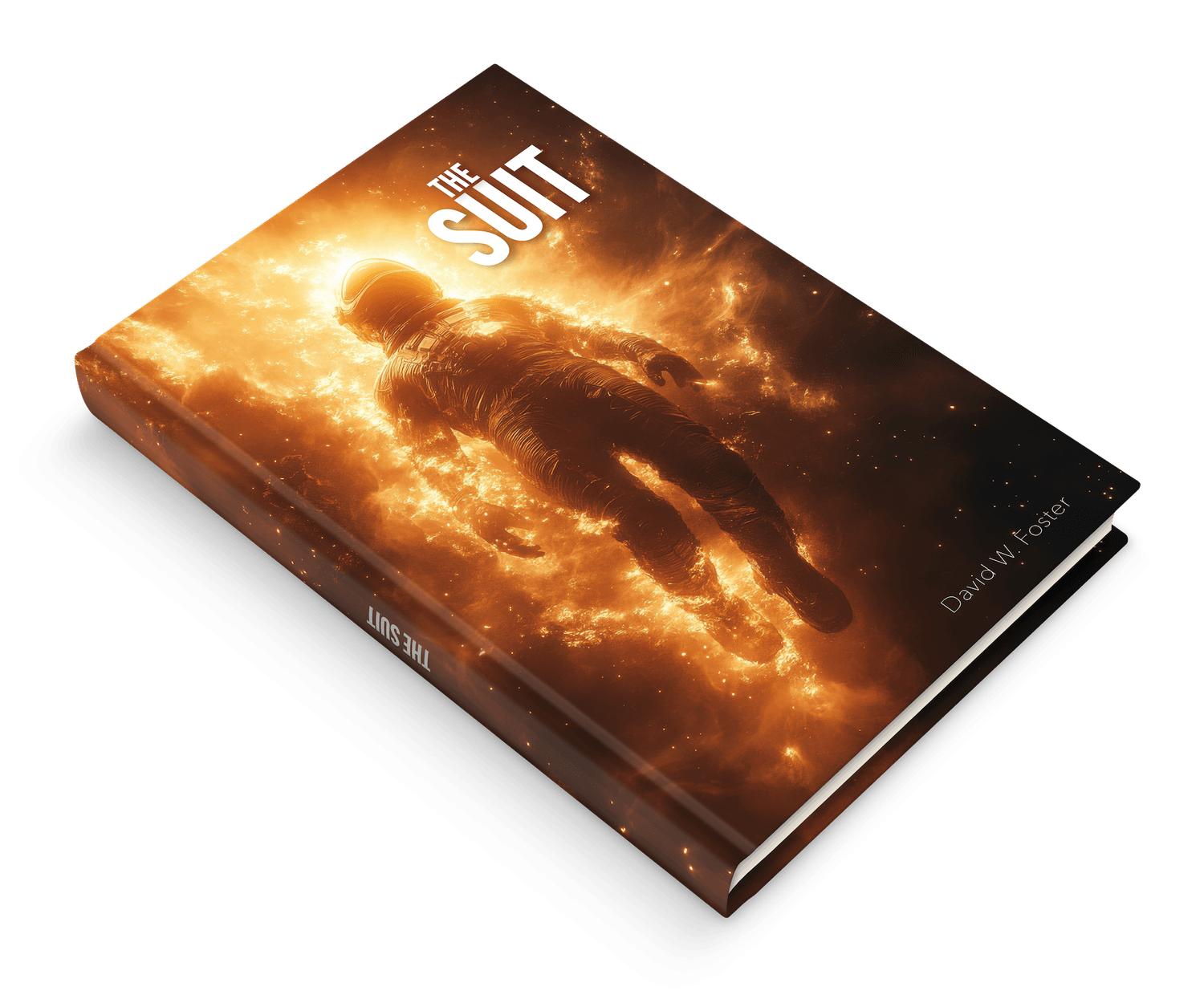
An astronaut is cast adrift in space after becoming untethered from his spacecraft. He is told to rely on his newly designed space suit that should carry him to safety.
The suit is designed using bio technology and is pretty much fully autonomous.
It doesn’t want the astronaut to suffer a long drawn-out death and is preparing to pull the plug!
Chapter 1 of 5
Two Years Ago
Following six-months of mind-bending work, and after making a major contribution to the classified AEGIS development program, it was time for Sarah to gear up for a new mission to examine how minimal gravity influenced mycelium networks and fungal organisms for the Mars Life scientific programme.
Sarah Kaine, astronaut and commander of the Andromeda spacecraft was raring to go. She had devoted years to training for this position. The time she had spent helping to perfect the AEGIS microgravity adaptations, and her meticulous attention to detail had earned her the respect of the entire AEGIS engineering team. The innovations she'd implemented would help to protect astronauts from radiation exposure and enhance mobility during extended spacewalks.
Now, with her work done, Sarah could barely contain her excitement about applying her knowledge to the Andromeda mission. She spoke of little else during their evening video calls, her eyes alight with that familiar determination that her husband Alex had always found both inspiring and slightly intimidating.
On the day of the accident, Andromeda was scheduled for a routine cargo deployment to the new International Space Station in low orbit around Earth. The Andromeda crew had performed flawlessly, executing the necessary procedures as they docked with the station. Once her crew was safely onboard the ISS Sarah ran final checks on the shuttle’s flight deck, when an unexpected and catastrophic failure occurred in the propulsion system — a malfunction that would prove fatal.
A critical macro-processor had deteriorated during launch due to a manufacturing defect, a flaw that had eluded all pre-flight inspections. When Sarah activated the shuttle’s micro-thrusters to manoeuvre it into deployment position, the compromised system simply overheated and exploded a chain reaction. The blast wave shattered the cockpit, igniting fuel, releasing docking mechanisms and sending the shuttle spinning out of control, vaporising it in an incandescent pyre against the backdrop of space.
Alex had been monitoring the mission from the ground, filled with pride and anticipation. When the alarm bells rang and the reports flooded in, every word felt like a dagger to his heart. In those agonising moments, he had fallen into total despair, pacing the control room with a restless energy that mirrored the chaos around him. The world outside his head seemed to dim as he clung to the desperate hope that he might still hear her voice, that somehow she had survived the chaos.
In the aftermath, investigation teams scoured the debris field, looking for answers. The loss of the Andromeda affected not only the nation but the entire world — a collective mourning that swept over every space enthusiast, every scientist, and every family member. The tragedy was heavily publicised, with investigations revealing shoddy production inspections, ultimately leading to widespread changes in manufacturing safety protocols. All too late for Sarah.
Months passed — long, torturous months for Alex — filled with grief and guilt. A mission that had been a beacon of hope revealed the arbitrary cruelty of fate. He pondered again and again the cruel irony that a woman so deeply invested in advancing humanity had met such an untimely end due to human error. Sarah's dreams lingered in his mind, haunting him like ghosts, accentuating the void she had left in their shared life.
Alex found himself spiralling into a deep depression, haunted by the memories of Sarah's laughter and her unwavering determination. He often revisited their nights picnicking under the stars, staring in awe at the galaxy, contemplating the vastness of the universe and the possibilities it held. Those moments now felt distant — tarnished by grief and longing.
He grappled with the sudden absence of her fierce spirit, the way she had inspired him to forge ahead, to aim higher. The countless conversations about the future they had imagined seemed mocking in retrospect, each ideal unfulfilled like a promise unkept. After Sarah's death, he discovered a profound sense of emptiness; there was no one to share his dreams, no companion with whom to conquer the challenges of space or of life.
At work, he threw himself into projects, desperate to distract himself from the gnawing pain. For the last two years he had immersed himself in the launch of Project AEGIS, channeling his grief into a commitment to honour her memory. He often wondered what Sarah would think of the advancements being achieved, how she would rally the team with her infectious excitement.
And in that lonely silence, the thought persisted: they were together in spirit, intertwined like the stars they loved. Each day was a struggle against the current of sorrow that threatened to pull him under, yet it was also punctuated by a flicker of resolve. The belief that he could continue her legacy, that they could conquer the unknown realms of space together—only now, she was a part of this journey in an entirely different way…
* * *
#### Present Time
The Helios Space Station hangs against the vast emptiness like a delicate crystalline sculpture, its solar arrays extended like the wings of some great dragonfly. Positioned at 931,000 miles distant from Earth (the L1 Lagrange point—that perfect gravitational balance between Earth and Sun) it represents humanity's most advanced space research platform. From this vantage, humanity's best and brightest scientists study solar phenomena with unprecedented clarity while the station's revolutionary shield arrays protect them from the increasingly violent solar storms that have been battering Earth's magnetosphere for the past decade.
Onboard the decelerating Q1 Zenith Starship 150 miles out Alex Kaine is staring through the main viewport and thinking it is probably one of the most beautiful things he has ever seen, and a welcome sight after thirty days travel from Earth.
He heads to the common area, where the smell of freshly brewed coffee fills the air. The aroma is a small comfort in the sterile environment of the spacecraft that he shares with 90 fellow astronauts, who are preparing to relieve the current space station crew.
Alex pours himself a mug of coffee and takes a sip, feeling the caffeine begin to energise him. He finds a vacant table and pulling out a holo-tablet begins to review the mission schedule. There are several EVA (Extravehicular Activity) operations planned, nothing he can't handle, but what is really getting him excited is the first operational mission for Quantum Aerospace's cutting edge space suit. The very latest innovation in bio-technology and he is the alpha test-pilot.
"Crew, proceed to docking stations" comes the ship-wide announcement half-an-hour later as the craft approaches the space station and prepares to dock.
* * *
The moment the starship secures its gigantic docking clamps, a carefully choreographed chaos erupts throughout both vessels. One hundred and eighty souls — ninety relief crew arriving and ninety outbound personnel preparing to depart — move with practised precision through the gleaming corridors.
"Twenty-four hours, people!" station Commander Rivera's voice echos through the comm system. "Not a minute more."
The countdown has begun. In just one solar day, the Zenith will detach and begin its month-long journey back to Earth, carrying those who have completed their half-year stint aboard Helios. Meanwhile, the massive neutron light cells that drive the starship's engines are already being extended like metallic petals, drinking in the unfiltered solar radiation necessary to power it for the return journey.
In the central hub, Lieutenant Dubois orchestrates the transfer of supplies with military efficiency. "Medical provisions to Bay Three! Agricultural samples to Lab Seven!" Her voice cutting through the controlled bedlam as hovering cargo platforms glided past, laden with everything from hydroponic seedlings to replacement circuit boards.
Down in Engineering, Chief Kowalski stands shoulder-to-shoulder with his replacement, their faces illuminated by holographic schematics of the station's life support systems.
"She runs hot in the eastern quadrant," Kowalski explaines, his weathered fingers tracing a pattern of red indicators. "Nothing dangerous, but you'll want to rotate the thermal shields every seventy-two hours instead of the standard ninety-six."
His replacement, a more than capable young woman with eager eyes, nods and makes notes on her tablet. "What about the atmospheric scrubbers?"
"Best tech crew in the fleet," Kowalski says with a hint of pride. "The scrubbers are maintained on a six-hourly schedule. Keep that up and you won't have any issues."
Throughout the station, similar scenes play out as knowledge, responsibility, and authority transfer hands — digital manifests verified with retinal scans, security protocols updated, research projects are handed over with meticulous care.
Commander Rivera observes it all from the command deck, her dark eyes taking in every proceedure. Unlike the others, she would remain as the one constant aboard Helios. This is her third crew rotation in a two-year assignment as station captain, and she has another six months before she sees Earth again.
She catches her own reflection in a darkened monitor—the slight greying at her temples are more pronounced than when she first arrived. Rivera straightens her uniform tunic and turns her attention back to operations.
The thought of Earth — its open skies and unpredictable weather — seem almost alien now. Here, among the stars, everything is measured, controlled, purposeful. Just as she prefers it.
"Status report on the neutron cell recharge?" she requests, her voice betraying none of the melancholy that can occasionally surface during these transitions.
"Thirty-two percent and climbing steadily, Commander," replies her new First Officer, still finding his footing in the role.
Rivera nods, satisfied. "Good. Let's keep it that way."
She has no time for homesickness or sentimentality. After all, Rivera likes to get on with the job in hand — and for now, that job is nearly a million miles from Earth, this place in space is exactly where she belongs.