The Suit
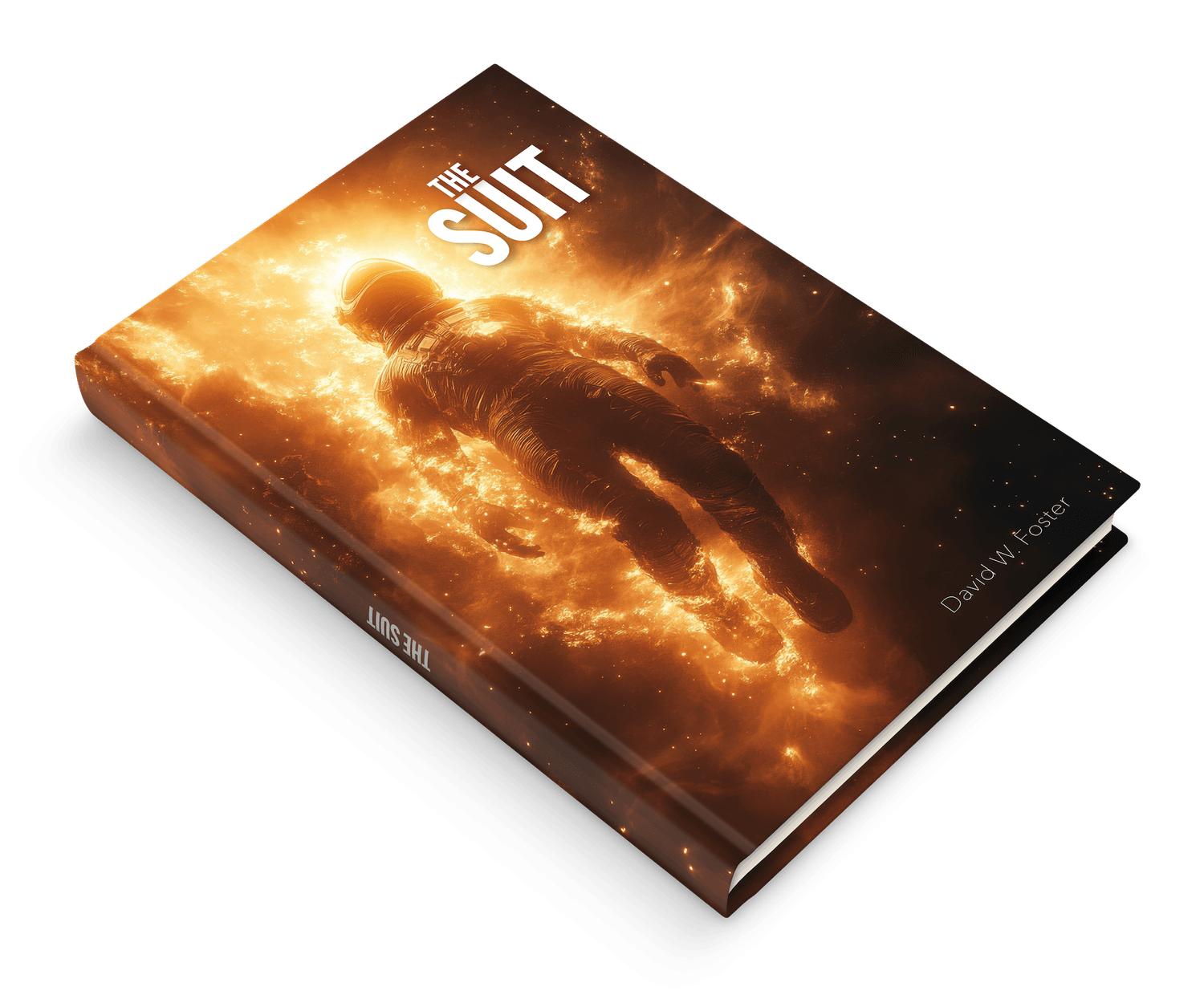
An astronaut is cast adrift in space after becoming untethered from his spacecraft. He is told to rely on his newly designed space suit that should carry him to safety.
The suit is designed using bio technology and is pretty much fully autonomous.
It doesn’t want the astronaut to suffer a long drawn-out death and is preparing to pull the plug!
Chapter 2 of 5
Twelve hours later the crew turnaround is almost done onboard the enormous structure.
"Time to go to work," thinks Alex as he floats gravity-free in the final prep chamber, carefully watching as technicians perform the last adjustments to the AEGIS suit's growth pod. Golden strands of bio-fabric catch the light as they work, giving the advanced spacesuit an almost mystical appearance.
"Feeling ready?" Dr. Elise Chen asks, her holographic tablet displaying final diagnostics as she approaches the chamber’s viewing wall. The blue glow of the tablet reflecting in her dark eyes, gives them an intensity that matches her reputation as the brilliant but demanding lead developer of Project AEGIS.
Alex nods, the practiced confidence of fifteen years in orbital operations evident in his relaxed posture. His weathered face showing the subtle signs of prolonged exposure to microgravity — a slight puffiness around the eyes, the thinning at his temples where the hair has receded faster than it should for a man of forty-two. "Just another spacewalk, right?"
Elise's expression remains serious. "This is hardly 'just another spacewalk,' Alex. The AEGIS system is a quantum leap in astronaut protection." She gestures through several screens on her tablet, checking calibration numbers with the precision that has made her the youngest and most admired development head in Quantum Aerospace's history.
"I've read the manual," he says with a half-smile. "Several times, actually."
But, this is Alex’s first mission in two years. That’s how long it had been since the devastating loss of his wife Sarah.
* * *
Alex is shaken out of his reverie as Elise steps closer, lowering her voice. "Reading about it and experiencing it are entirely different matters,” she says. ”This suit isn't just a protective shell like previous generations. It actively cares for you. The bio-neural interface monitors everything — heart rate, blood chemistry, brain activity — and it responds before you even register a need."
Alex raises an eyebrow. "So I'm basically wearing an overprotective mother?"
Elise doesn't laugh. Her dark eyes hold his gaze with unexpected intensity. "Don't underestimate what we've created, Alex. This suit values your life above all else."
Something in her tone makes the joke die in mid-air. Before he can respond, Commander Rivera enters the antechamber, her military bearing evident in every precise movement. At fifty-six, Carmen Rivera is a legend in space operations, her silver-streaked hair pulled back in a tight bun, her spine ramrod straight despite two decades working in microgravity. When she speaks, everyone takes notice.
"Final briefing in five minutes," she announces. "The latest solar forecasts just came in. We have a narrower window than anticipated."
* * *
The suit-up process is unlike anything Alex has experienced before. Rather than the typical four-hour-long procedure of donning a conventional spacesuit — layer by layer with the help of multiple technicians — AEGIS practically assembles itself around him. As he floats into the clear gravitube and steps onto the zero-gravity base platform, a golden material flows up his body like liquid metal seeking its form, the mycelium growing around him, individual cells communicating with each other to create perfect bio-seals to balance pressure across his skin. As the AEGIS suit continues to form, Alex feels a bittersweet pang, wishing Sarah could witness the culmination of this amazing work that will protect future astronauts.
"Neural interface engaging in three, two, one..." a technician counts down.
Alex feels a brief, sharp sensation at the back of his neck as the interface connects, then a wave of warmth spreads throughout his body. For a disorienting moment, it feels as if he has grown a second skin, his neurological map expanding to incorporate the suit's bio-systems.
"Whoa," he breaths, involuntarily rapid blinking. He regains his senses to experimentally roll his shoulders and flex his fingers. The suit's skin-tight membrane moves in perfect synchronicity, without the usual delay or resistance of standard EVA equipment.
"Neural handshake successful," Dr.Chen reports, watching the data streams on her tablet. "Integration at 92% and climbing—that's higher than any of our previous test subjects achieved in the initial connection."
Looking down at his new golden body-shell Alex murmurs. “Okay... Let's get acquainted."
Ten seconds later, hell breaks loose!
* * *
The anteroom is buzzing with tension. Holographic displays are showing massive coronal activity on the sun's surface — angry red and orange swirls punctuated by brilliant flashes of magnetic reconnection. Long, glowing filaments of plasma arcing thousands of kilometres into space before collapsing back onto the hellish churning surface.
Commander Rivera stands before the main screen. "The situation is deteriorating faster than predicted. The Helios shield arrays are experiencing power fluctuations that our internal diagnostics can't pinpoint. Without stable shields, the next major flare could fry every system on this station and expose everyone to lethal radiation doses."
A hushed murmur spreads through the assembled team — twelve specialists representing the station's departments, from life support to astrophysics. The gravity of the situation isn't lost on any of them. Helios had been designed to withstand solar activity, but the current storm cycle has broken all known records.
She points toward the station schematics displayed on an adjacent screen, the detailed 3D model rotating slowly. "The issue appears to be located in junction Alpha-Seven, near the primary array articulation point. Standard remote diagnostics have failed, necessitating manual inspection."
Rivera gestures a section of the schematic, and it expands to show the external components where the shield's power regulation systems connected to the main array. A flashing red indicator marking the suspected failure point.
“I guess this is where I come in," Alex says.
"Precisely," Rivera confirms. "You'll conduct a detailed inspection and emergency repair if possible. The AEGIS suit provides optimal protection against the heightened radiation levels at that exposure point." She turns to Dr. Chen. "Doctor, would you like to elaborate on the suit's capabilities?"
Elise steps forward, activating a different display that shows a rotating 3D model of the AEGIS system. The holographic projection highlighting different components of the suit's construction — from the outer radiation-resistant shell to the inner neural mesh that will bond directly with Alex's nervous system.
"The Autonomous Environmental Guardian and Intelligence System represents ten years of intensive development. The key innovation is the maternal algorithm that governs the mycelial bio-s (friendly fungi) embedded throughout the suit's structure."
She expands the display to show microscopic images of the tiny biological forms. "We found that training these bio-s with nurturing instincts creating an unprecedented level of responsiveness. They don't just follow protocols — they anticipate needs based on a sophisticated understanding of human physiology and psychology."
The display shows a simulation of the bio-s responding to various emergency scenarios — instantly hardening to protect against micrometeoroid impacts, reconfiguring to seal punctures, adjusting internal atmosphere to compensate for stress responses, like an army of tiny micro-worms working to protect their host.
"The suit has undergone extensive testing in simulated environments," she says, "but this will be its first operational deployment in total vacuum conditions."
Alex notices the subtle exchange of glances between Elise and Rivera — something unspoken passing between them. He has been in space operations long enough to recognise when information is being filtered.
"Is there something I should know?" he asks directly, his gaze moving between the two women.
Rivera clears her throat. "The AEGIS project is... slightly ahead of its scheduled deployment phase. Under normal circumstances, we would conduct at least nine more months of testing before field deployment."
"And these aren't normal circumstances," Alex concludes.
"The solar activity has increased 47% beyond projections made just two months ago," Rivera explaines. "We're facing a perfect storm of heightened solar activity and now critical shield malfunctions. Without intervention, we're looking at potential total station loss within 72 hours."
Everyone is silent as the implications sink in. Helios represents not only billions in investment but also humanity's most advanced platform for studying the increasingly volatile sun. Its loss would be catastrophic for both space science and Earth's early warning systems for solar events. Also, their very lives are on the line.
"The decision to deploy AEGIS now has not been made lightly," Elise adds. "But the suit offers protection levels no conventional EVA equipment can match. With the radiation levels we're experiencing, it's actually safer than waiting for the next development window."
Alex studies the faces on the other side of the antechamber viewing port — the tight expressions, the subtle tells of people not saying everything. He knows exactly when mission parameters include unspoken risks.
"There's something else," he presses. "Something about the suit you're not telling me."
Dr.Chen exchanges another look with Rivera before responding. "The autonomous bio-systems are... highly advanced. In simulation testing, we've observed the suit making decisions that occasionally prioritise protecting the host over mission objectives."
"Meaning?"
"Meaning it might try to bring you back prematurely if it determines conditions are becoming unsafe," Rivera says bluntly. "You may need to override its protective instincts to complete the repairs."
Alex nods slowly. "So I need to convince my overprotective space-mom to let me stay out past curfew."
This time, a few nervous chuckles brake the tension. Elise manages a smile, though it doesn't reach her eyes.
"Something like that," she confirms. "The link between you and the suit will be intuitive, but remember — you remain in command. The override protocols are detailed in section seven of your briefing materials."
Alex calls up the mental image of the document he has studied. The override procedures had seemed straightforward enough during his review, though oddly complex for what should be a simple safety feature. Twenty-seven distinct command sequences, each requiring precise neural impulse patterns to execute.
"AEGIS Launch window opens in forty minutes," Rivera announces, ending the briefing. The 3D displays shift to launch countdown and final preparation checklists. "Final suit-up procedures are complete. Good luck, Alex. We're all counting on you."
As the anteroom clears, Alex catches Elise lingering by the door. "Doctor Chen. Anything else I should know?"
She hesitates, then turns to step closer to the viewing port. "The suit learns from you — your responses, your decisions. The longer you're connected, the more attuned it becomes. If you start to feel... unusual sensations or thoughts while wearing it, that's normal. It's the neural interface establishing deeper connections."
"Define 'unusual,'" Alex says.
"You might experience heightened intuition or awareness. Some earlier test subjects reported feeling like they could anticipate problems before they occurred." She pauses. "Others described it as feeling... accompanied. Not alone, even in isolation."
Alex studies her face. "That sounds almost spooky.”
"It's just advanced technology," Elise says quickly. "The brain interprets the neural feedback in familiar terms. Just remember, no matter how it feels, the suit is only a tool. Your tool."
She leaves before he can ask any more questions, leaving Alex with an unsettled feeling that has nothing to do with the approaching spacewalk.