The Suit
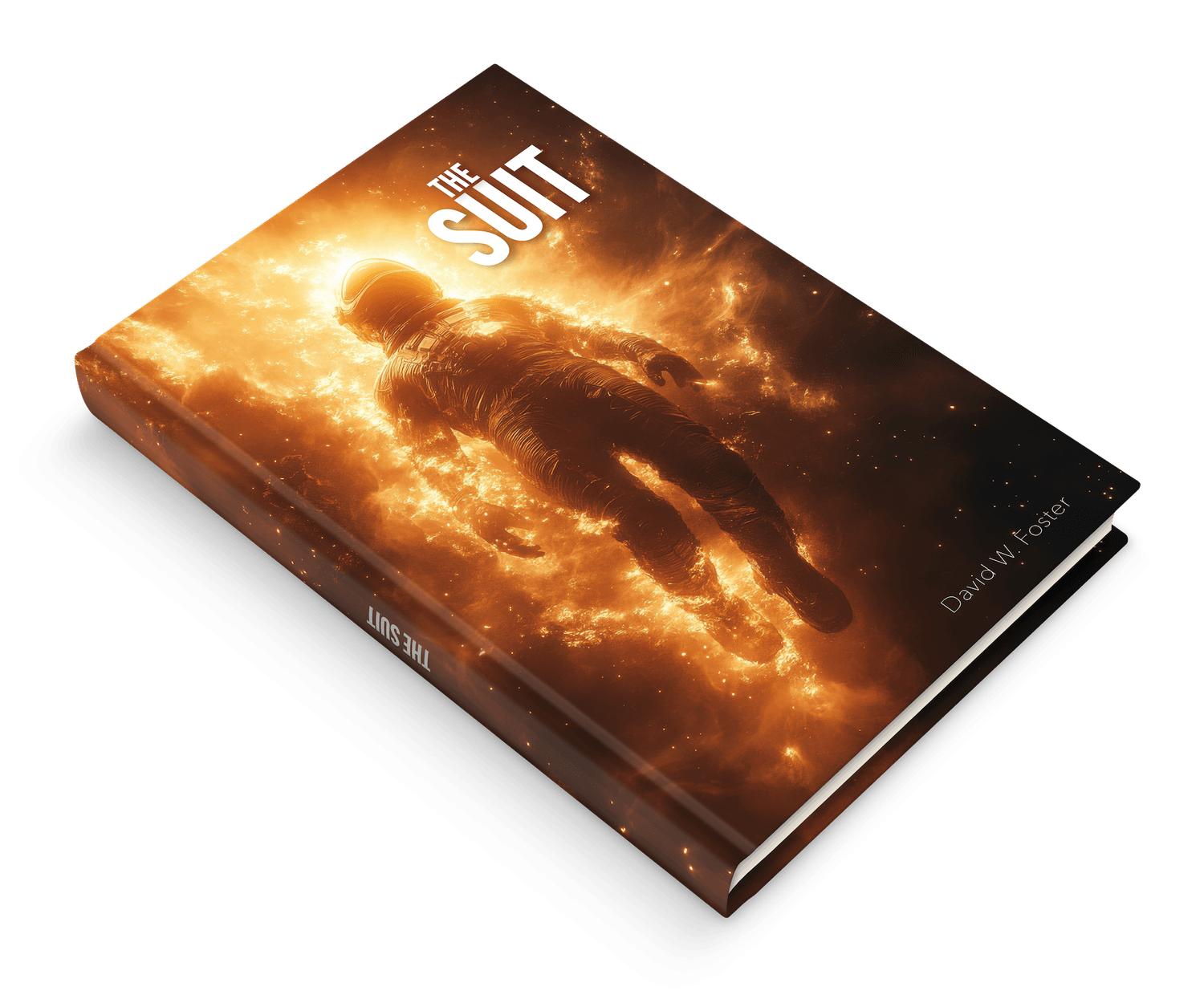
An astronaut is cast adrift in space after becoming untethered from his spacecraft. He is told to rely on his newly designed space suit that should carry him to safety.
The suit is designed using bio technology and is pretty much fully autonomous.
It doesn’t want the astronaut to suffer a long drawn-out death and is preparing to pull the plug!
Chapter 3 of 5
The airlock cycles with the hiss of equalising pressure. Alex floats in the chamber, already noting the difference between AEGIS and every other suit he has worn throughout his career. Where traditional EVA suits felt bulky and restrictive, AEGIS moves with him like a second skin. The golden-hued bio-material seems to anticipate his movements, flexing microseconds before his muscles do.
The neural mesh linked to his spine hums with gentle energy, sending tendrils of sensation throughout his nervous system. It isn't uncomfortable — rather the opposite. The connection feels natural, as if the suit is a part of him that had been temporarily separated and now reunited.
"Systems check complete," he reports as the outer door begins to open. "Neural interface is... interesting. Definitely more responsive than the training simulations." His voice sounds different to his own ears—richer, clearer, as if the suit is optimising even the acoustics within his head gear.
"That's expected," Elise's voice comes through the comm crystal clear. "The simulations can't fully replicate the quantum-level interactions between your nervous system and the bio-s in a live scenario."
The airlock door completes its cycle, revealing the breathtaking expanse of space. No matter how many times Alex has done this, the vastness of space is awesome. The sun blazing in the distance, noticeably more active than normal, its surface churning with storms and prominences. Turning, the Earth hanging in the vastness, like a beautiful blue marble.
"Beginning EVA," Alex announces, pushing gently out of the airlock.
* * *
The sensation is unlike any spacewalk he has experienced before. The AEGIS suit doesn't just protect him from the vacuum — it extends his senses. Alex can feel the subtle radiation pressure from the sun against the suit's surface, the minute temperature differentials between sunlight and shadow, the electromagnetic field of the station itself.
The tether connecting him to the station plays out behind him as he navigates toward the damaged section. Using a combination of handholds and the suit's micro-thrusters, he makes his way along the station's exterior with practiced ease.
"How does it feel?" Elise asks.
"Like it's reading my mind," Alex says, as he manoeuvres around a communications enclosure "I barely need to think about a movement before the suit's already helping me make it."
"That's the predictive motor assistance. The bio-s monitor micro-muscle contractions that precede voluntary movement." She almost sounds excited.
Alex approaches the articulation point, the golden reflection of his suit visible in the station's mirror-like surface. "Approaching Alpha-Seven now. Initial visual inspection shows scorching around the housing."
He anchors himself to the station's framework and begins removing the external cover. As he works, he becomes increasingly aware of the suit's subtle adjustments—maintaining his optimal position, stabilising his movements with micro-corrections, even adjusting the pressure around his fingers to enhance dexterity.
The precision is remarkable. Tasks that would have been challenging in a standard EVA suit became almost effortless, as if the AEGIS is an extension of his will rather than a separate tool.
"I'm detecting unusual power signatures," he reports as the panel he is working on comes free. "There's evidence of an electrical arc that has damaged the primary conduit. I can see where it melted through the insulation."
Inside the damaged junction area, a complex array of power regulation systems connecting the station's main reactors to the shield generators shows clear signs of damage — blackened circuitry and melted connection points where power surges have exceeded normal tolerances.
"Can you effect repairs?" Rivera's voice now.
Alex examines the damaged components. The suit enhancing his vision to show thermal patterns and electrical fields that would normally require complex equipment to fix. "Affirmative. I'll need to bypass the damaged section and replace the control module. Estimate thirty minutes for complete repair."
"Proceed," Rivera says. "Solar forecasting shows increasing activity. We need those shields at full capacity as soon as possible."
As Alex works, he becomes aware of a strange sensation — a warmth spreading across his chest and down his arms that has nothing to do with temperature regulation. The suit seems to be... pleased? The notion is absurd, yet he can't shake the feeling that the AEGIS system is somehow satisfied with his progress.
"Dr.Chen, I'm noticing some unusual feedback from the neural interface. It feels like... emotional contentment."
After a brief pause she responds. "The interface is interpreting efficiency as positive feedback. What you're feeling is the suit's optimisation algorithms confirming successful operation."
The explanation makes sense, but doesn't quite match what Alex is experiencing. This feels more personal somehow, like the approval of a teammate rather than a machine's operational confirmation.
He continues the repairs, replacing damaged circuitry and rerouting power channels. The work is precise and demanding, but the suit makes it feel almost effortless, enhancing his movements with perfect micro-adjustments. When he needs a tool, the suit seems to anticipate which one before his hand even reaches for his tool belt.
"Final connections complete," he reports after twenty-six minutes of intense focus. "Running diagnostics now."
The junction point hums back to life, status indicators shifting from red to green as systems come back online. "Control, we have successful restoration of primary shield articulation systems. Shield efficiency should return to optimal levels momentarily."
"Excellent work, Alex," Rivera's voice contains rare warmth. "Return to — "
* * *
Her words cut off as a proximity alert blares through the comms. Alex's HUD flashes red warning indicators, and a cascade of data scrolls across his vision — solar wind velocity increasing exponentially, radiation levels spiking, electromagnetic disturbance patterns escalating beyond predicted parameters.
A sudden shudder as a power surge hits the Helios without warning.
"What the?" Alex shouts.
"Major solar event!" Elise's voice, urgent now. "Alex, return immediately. The arrays are destabilising due to the power surge!"
Alex doesn't need to be told twice. He secures his tools and begins moving quickly back toward the airlock, using the station's handrails to pull himself along while the suit's thrusters provide additional momentum.
"Time to impact?" he shouts again to make himself heard above the chaos.
"Seven minutes," Rivera responds. "The flare's magnitude exceeds that last hit. It's coming in harder and faster."
Alex increases his pace, feeling the suit responding to his heightened adrenaline by enhancing his strength and speed. He's making good progress when he notices something strange—the suit has tightening around his limbs, the material stiffening against his skin.
"Control, I'm feeling unusual activity in the AEGIS system," he says. "The bio-bots are reconfiguring, and they're doing it fast!"
"That's by design," Elise cuts in. "The suit is adapting to the increased radiation. Trust the system, Alex."
The distant sun flashes brilliantly, and Alex's HUD momentarily dims to protect his vision. The radiation counters spike as the leading edge of the flare's energy particles wash over the station.
"Four minutes to main impact," Rivera warns. "Hurry, Alex!"
He is less than fifty meters from the airlock when the second, more powerful wave hits. This isn't just radiation — it's a massive electromagnetic pulse that strikes the station with devastating force. The primary docking arm where Alex is anchored shudders violently, metal straining under immense pressure.
Without warning, the connection point shears away in a shower of metal fragments. Alex feels a sudden moment of weightlessness as his tether slackens, then the horrifying sensation of drifting away from the station.