The Suit
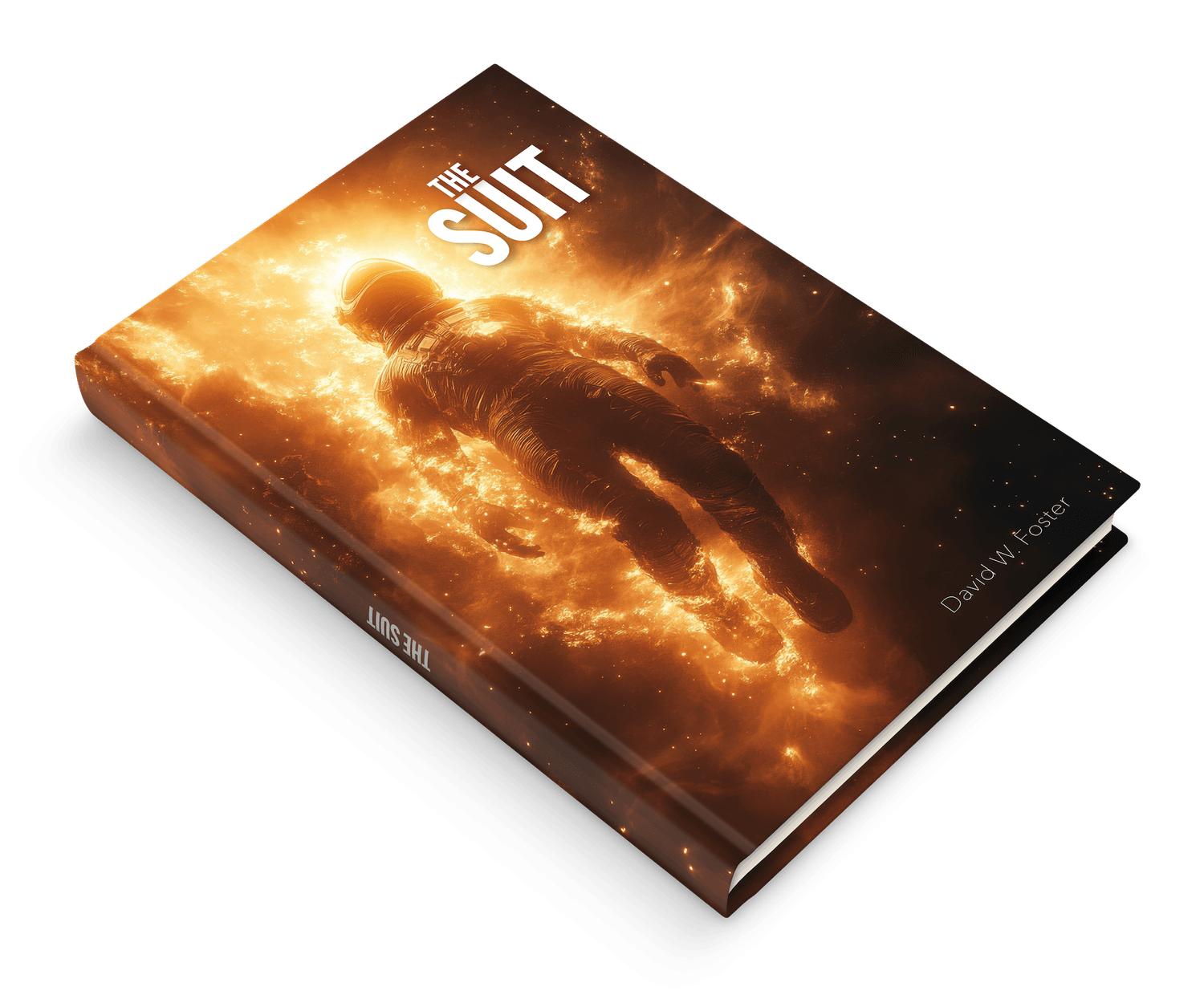
An astronaut is cast adrift in space after becoming untethered from his spacecraft. He is told to rely on his newly designed space suit that should carry him to safety.
The suit is designed using bio technology and is pretty much fully autonomous.
It doesn’t want the astronaut to suffer a long drawn-out death and is preparing to pull the plug!
Chapter 4 of 5
Commander Rivera's voice crackles through chaotic static. "Alex! Status!"
"I'm adrift!" Alex fighting to keep his voice calm as realisation kicks in. His hand instinctively reaches for the emergency propulsion unit on his belt, only to find it unresponsive. "EPU is down — likely fried by the pulse."
The Helios station is already receding at an alarming rate. He can see its thrusters firing in short, controlled bursts — the automatic stabilisation programs responding to the impact.
"AEGIS power systems intact," he continues, mentally calculating his trajectory. "But I'm moving away at approximately three meters per second. Request immediate rescue procedure."
The comms channel is filled with urgent voices and rapid-fire technical exchanges. Alex can hear the controlled chaos of the control room as the crew assesses their options. Finally, Rivera's voice cuts through the noise.
"Alex," she says, her tone deliberately measured, "the station's manoeuvring thrusters are locked in emergency stabilisation mode. We can't launch a retrieval craft for at least forty minutes."
Forty minutes. The calculation is brutally simple. At his current velocity, he'll be nearly seven kilometres from the station by then — beyond standard retrieval parameters even in optimal conditions.
"Dr. Chen," Alex calls, watching the slowly decreasing oxygen indicator on his visual display. "You said this suit was designed to keep me alive. Now would be a good time to tell me how."
"The AEGIS system was built for scenarios like this," Elise responds, though Alex detects a tremor in her usually confident voice. "The suit has autonomous navigation capabilities. It can serve as a personal spacecraft for up to seventy-two hours."
She hesitates before adding, "But we've never tested it under these exact conditions."
Alex feels a subtle change in pressure around his limbs as the suit seems to respond to Elise's words. The heads-up display blinks, now streams of code scrolling too fast to read.
"The bio-s are self-organising," Elise explains. "They'll form propulsion structures to guide you back. But Alex—" Her voice drops. "The system is still experimental. The autonomous functions were scheduled for the next test phase."
"So I'm the test phase," he thinks grimly, staring at the rapidly diminishing station.
* * *
Inside Helios control, alarms continue to sound as systems struggle to compensate for the damage caused by the solar flare. Rivera standing at the central console, her face illuminated by the red emergency lighting.
"Engineering, I need options for retrieval," she demands. "What about the manned retrieval pod?"
"Pod systems are compromised," the chief engineer replies. "The EMP damaged its guidance systems. We'd be sending another person out to drift."
"The backup shuttle?"
"Forty minutes minimum to prep. It's powered down in the secondary bay."
Rivera slams her fist on the console. "That's not acceptable. We have a man drifting into space!"
Elise stands slightly apart, her attention focused entirely on the biometric data streaming from Alex's suit. The numbers tell a story beyond his vital signs—the AEGIS system is consuming power at an unprecedented rate, redirecting energy to its bio-s matrix.
"Alex, listen carefully," she says, forcing calm into her voice. "The suit's primary directive is to keep you alive. But its definition of 'alive' might not align with yours. You need to maintain conscious control of the system."
Alex watches as his visuals flicker, then stabilise into a new configuration. A soft, almost melodic hum emanating from within the fabric itself as the bio-s rearrange their molecular structure.
"I'm detecting some sort of autonomous activation," he reports, feeling a strange warmth spreading across his chest. "The suit is... I don't know how to describe it... it feels like it's learning me."
His relationship with technology has always been straightforward. From his first spacewalk to commanding complex orbital repairs, Alex has treated each suit and tool as just that — a tool. But AEGIS feels different. Even during the preliminary training sessions, he'd sensed something more intuitive, more aware than any equipment he'd used before.
"The bio-s are accessing your biometric data," Elise says. "Heart rate, neural patterns, stress indicators — it looks as if they're establishing a baseline to better protect you."
What she doesn't say is that this deep scanning is never meant to occur while the suit is in emergency mode. The combination of solar radiation, the electromagnetic pulse, and the stress of sudden detachment has created conditions unlike anything in their simulations.
"My HUD is showing some internal reconfiguration," Alex says, watching as golden filaments spread across the interior surface of his visor. The bio-s are forming new structures, creating intricate patterns that start to pulse in rhythm with Alex's heartbeat. The golden filaments branching outward like a mycelium network, their movements now synchronised with his own brain activity. Alex feels a strange tingling at the base of his skull where the neural interface has connected.
"This is unexpected," Elise's voice has acquired an edge of urgency. "The suit shouldn't be forming those structures without receiving authorisation from both you and me."
The stars seem to stretch and blur as Alex continues to spin away from the Helios Station. Earth just a tiny blue dot, getting more distant with each passing second.
* * *
"It's responding to the emergency," Alex replies, trying to keep his breathing steady despite the mounting anxiety. "Is this part of the maternal algorithm you described?”
There's a pause before Elise answers. "Yes, but accelerated. The AEGIS system has been designed to gradually bond with its user over weeks, not minutes. The solar flare must have triggered its protective protocols."
All around her warning klaxons blare as another system failure alert lights up the main console. Commander Rivera moves with furious efficiency, directing the crew as they fight to stabilise the station's critical systems.
"Radiation shielding down to 42% capacity," reports the systems engineer, his face a ghostly glow in the red emergency lighting. "Primary coolant loop is showing pressure fluctuations."
"Divert power from non-essential systems," Rivera snaps. "Shut down all research modules except life support. Priority one is stabilising the shield arrays."
Elise stands at her workstation, eyes transfixed on the neural activity readings streaming from Alex's suit. The patterns are evolving at an alarming rate, forming connections that shouldn't be possible in the suit's current operational phase.
"Dr. Chen," Rivera calls, striding over, "I need to know exactly what that suit is capable of. No more half-truths or classified protocols. What are we dealing with?"
Elise hesitates, then lowers her voice. "The AEGIS system contains advanced autonomous protocols that are still in development. Under extreme stress, it might... evolve beyond our predicted parameters."
"Meaning?"
"Meaning it might make decisions we didn't explicitly program."
Rivera's expression hardens. "Is it dangerous to him?"
"No," Elise says… too quickly. "Its core directive is absolute: protect the host at all costs. But how it interprets that directive under these conditions..." She lets the sentence hang unfinished.
* * *
Suddenly Alex cuts in. "This is... strange," he says, noticing how the suit is subtly shifting against his skin, as if taking measurements. "It's like the suit is hugging me."
"That's the adaptive pressure system," Elise replies, but her voice betrays uncertainty. "It should be optimising blood circulation and decreasing adrenaline to compensate for your stress response."
The suit's display flickers again, data streams reorganising themselves into more efficient patterns. The neural interface at the base of his skull hums with increased activity, sending waves of warmth throughout his nervous system.
Alex flicks off the comms “Hello?" he whispers, wondering if the suit can hear him without the comms system. "Are you... aware?"
The HUD flickers in response, and for a split-second, Alex sees a flash of a pattern that resembles a face in the scrolling data — something almost feminine and concerned. It disappears so quickly he can't be certain it isn't his imagination.
He flicks comms back on. "Control," he says, "the suit is showing signs of higher function. I'm getting feedback that definitely was nowhere in the manual."
On the space station, Elise freezes as the same momentary image flashes across her screen before being replaced by the suit's diagnostic data. She exchanges glances with her team, their worried expressions illuminated by the pulsing emergency lights.
"Alex, listen carefully," Elise says, choosing her words carefully. "AEGIS has been developed using a revolutionary neural mapping technique. We scanned the decision-making patterns of first responders, emergency medical personnel, and —" she hesitates, "— wives and mothers in crisis situations. The combined algorithm is meant to create the ultimate protective system."
What she doesn't reveal is the source of one of those neural patterns. That information is classified at the highest level — a bridge they will cross only if absolutely necessary.
"The suit feels... familiar somehow," Alex whispers. The golden tendrils have now formed a delicate lattice across his entire field of vision, pulsating in time with his physical functions, and cognitive rhythms.
Commander Rivera cuts in. “Your trajectory is taking you through a debris field," she warns, her voice strained as she juggles the dual crises of Alex's situation and the station's deteriorating systems. "Impact probability is rising. We're calculating a rescue pathway, but you need to activate the suit's propulsion now."
Quickly Alex tries to access the manual controls, but his fingers meet resistance — the suit is preventing him from reaching the emergency thrusters.
"It's not letting me," he says, an uncharacteristic note of panic entering his voice. "The suit is blocking manual override."
"It must be calculating a safer route," Elise whispers to herself. "Its avoidance algorithms are more sophisticated than standard evasive manoeuvres. Let it work, Alex."
The truth is that AEGIS has detected micro-fractures in its emergency propulsion system — damage from the EMP that human sensors wouldn't detect. The suit determines that activating the thrusters carries a 64% risk of catastrophic failure. Instead, it begins to reconfigure itself to create alternative propulsion, a capability that exists only in theory — and has never been implemented or even tested in the actual AEGIS system itself.
"Something's happening," Alex says, feeling a strange rippling sensation along his back. "The suit is... changing shape."
Commander Rivera quickly activates the station's high-powered observation scope, and goes to maximum mag. She looks through the scope in astonishment as the back of Alex's suit begins to bulge and reshape itself, then extrudes what look like delicate, translucent fins.
"My God," she whispers, "it's creating solar sails. The bio-s are forming radiation-harvesting membranes. The suit is going to use the solar wind as propulsion."
Alex feels a gentle tug as the newly formed structures catch particles streaming from the sun. The suit's HUD displays a new trajectory — a graceful arc that will eventually take him back toward the station, but not for hours. The path carefully avoiding the debris field Commander Rivera warned about.